
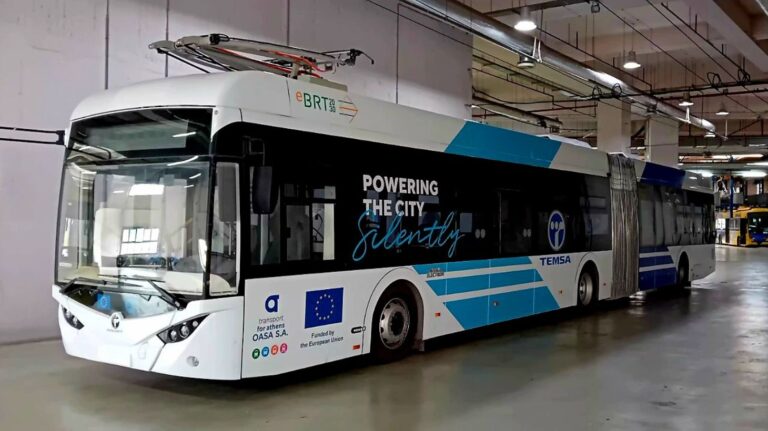
A live demonstration on 5 November will show how the Greek capital is electrifying a key bus corridor with the infrastructure it already has.
Athens will hold a live demonstration of an electric Bus Rapid Transit (e-BRT) service on Syggrou Avenue on Thursday 5 November. The pilot tests taking place in Athens aims to show how cities can electrify public transport without starting from scratch.
The pilot runs between Syggrou-Fix metro station and the Stavros Niarchos Foundation Cultural Center (SNFCC). Its electric buses charge on the move from Athens’ existing trolleybus lines and top up at the depot. This means the route can go electric without extensive new charging infrastructure.
 The demonstration is part of eBRT2030, a European research project funded by Horizon Europe. It is organised by the Athens Urban Transport Organisation (OASA) with its subsidiary OSY. Research partners are the I-SENSE Group of the Institute of Communication and Computer Systems (ICCS) and the Laboratory of Transportation Engineering at the National Technical University of Athens (NTUA).
The buses are supplied by TEMSA–Škoda, an eBRT2030 partner, and can charge from both overhead lines and stationary chargers. They are fitted with sensors and IoT systems linked to a digital twin and data management tools. These let operators track and optimise energy use, charging and day-to-day operation of the line.
“The demonstration on Syggrou Avenue represents a promising step towards bringing Athens closer to European advances in urban transport innovation” said Dr Angelos Amditis, Research and Development Director at ICCS / NTUA “By making smart use of existing infrastructure, we are showing that the green transition in public transport is achievable, sustainable and scalable”
Part of a wider European push
eBRT2030 brings together operators, authorities, manufacturers and researchers to develop the next generation of fully electric BRT for urban and peri-urban areas. The project covers the whole system: vehicles, charging and energy management, infrastructure, operations, automation and connectivity. It aims to show that electric BRT can be economically viable as well as clean. That means cutting emissions and congestion while lowering the cost per passenger-kilometre and the total cost of ownership for operators.
Rather than testing a single solution, each demonstration site tackles the challenges that matter most locally:
- Prague runs large-capacity battery trolleybuses with In Motion Charging on its airport line 119. This adds around 30% more capacity on the same timetable and saves roughly 1,300 tonnes of CO2 a year.
- Amsterdam operates BRT line 300 between Amsterdam, Haarlem and Schiphol, with around 340 trips a day. A limited grid connection is supported by a 1 MWh stationary battery and intelligent load management.
- Rimini has added active safety cameras, real-time passenger counting, predictive maintenance and a new charging station to its Metromare line.
- Barcelona combines smart depot charging, traffic signal priority at 17 intersections, a predictive demand model and upgraded passenger information on line H12.
Athens adds something new to this picture. It shows how cities with existing trolleybus networks can build on them to electrify high-capacity bus services.
“With five of seven sites now live, eBRT2030 is showing that electric BRT works in very different cities, and Athens shows what is possible when cities build on what they already have,” said Flavio Grazian of UITP, the project coordinator.
Event details
The morning programme at the OSY Rouf depot includes welcome addresses and a presentation of the Athens pilot. It is followed by demonstration rides from Rouf to Syggrou-Fix and the SNFCC and back.
Date: Thursday 5 November 2026, 09:00–12:00
Venue: OSY Rouf Depot, Athens
Attendance is by invitation only. For information or to request an invitation, contact Sevi Christoforou at sevi.christoforou@iccs.gr.