As climate risks intensify and emergency response scenarios grow more complex, the need for faster, smarter, and more coordinated public safety operations is becoming critical. Technologies are no longer evaluated only on performance, but on their ability to operate reliably in real-world, high-risk environments and deliver actionable insights in real time. Within this context, the Greek pilot of 6G-VERSUS moves beyond concept, demonstrating how next-generation connectivity, artificial intelligence, and autonomous systems can work together in the field to support early wildfire detection and search and rescue operations.
The 6G-VERSUS (6G VERtical trials for SUStainability) project is a Horizon Europe SNS JU initiative, currently in the second year of its three-year duration, aiming to make 6G tangible and measurable through large-scale trials with vertical services in critical sectors. Its primary objective is to transform existing services and use cases into 6G applications and validate them across six experimental platforms, both within and beyond the SNS ecosystem, with emphasis not only on technical performance but also on their broader environmental, societal, and economic impact. The I-SENSE Group plays a central role in the project.
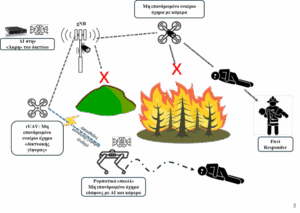
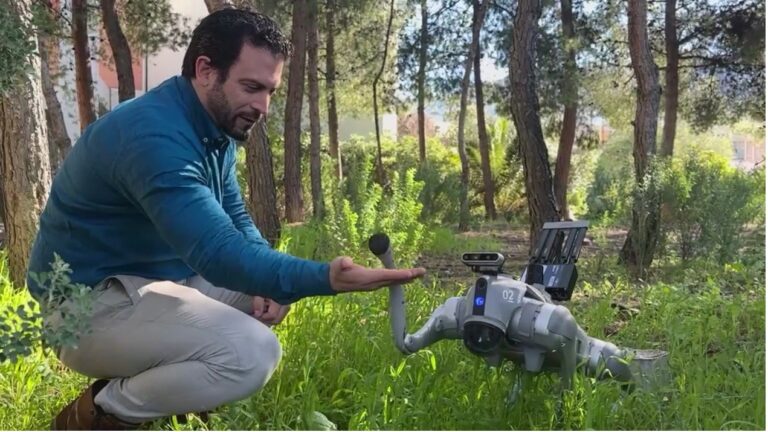
Recently, the Greek pilot took place in the premises of NTUA to provide a a clear demonstration of 6G applications for public safety operations, focusing on early wildfire detection and response/search and rescue scenarios. The approach is structured around the well-defined application triplet in 6G-VERSUS: the vertical application (V-App), the artificial intelligence application (AI-App), and the network application (N-App). Within this framework, AI, networking capabilities, and autonomous assets are orchestrated to support critical field operations.
The Greek pilot provides a clear demonstration of 6G applications for public safety operations, focusing on early wildfire detection and response/search and rescue scenarios. The approach is structured around the well-defined application triplet in 6G-VERSUS: the vertical application (V-App), the artificial intelligence application (AI-App), and the network application (N-App). Within this framework, AI, networking capabilities, and autonomous assets are orchestrated to support critical field operations.
Overall, the Greek pilot demonstrates how the coordinated use of AI, advanced networking, and autonomous systems can effectively support public safety operations, from early detection to search and rescue missions.
In terms of impact, although 6G-VERSUS comprises five additional pilots and six use cases, the Greek pilot provides a particularly clear illustration of how: • coordinated AI capabilities, • networking functionalities, and • autonomous systems can enhance critical public safety operations within a future landscape where vertical services are fully integrated with 6G and AI. In parallel, ICCS/I-SENSE will assess the impact of the Greek pilot’s 6G application both quantitatively and qualitatively, examining effects across environmental, societal, economic, industrial, and European market dimensions. This is essential, as sustainable 6G must be demonstrated through measurable indicators.
Visit the project’s website for more https://6g-versus.eu/ Furthermore, you can find an explanatory video of the Greek pilot here, as well as information about the role of I-SENSE in the project and the first testbed here.