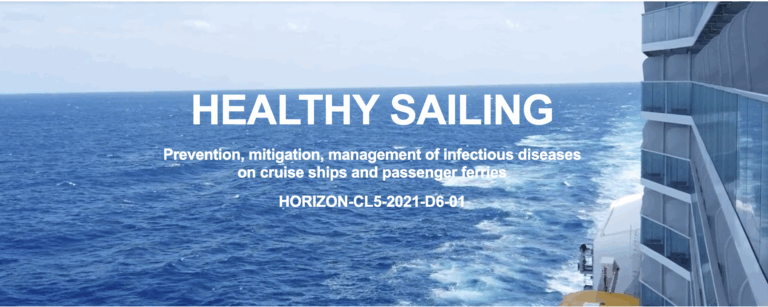
The European project Healthy Sailing is successfully concluding its activities, significantly strengthening health preparedness and surveillance in the cruise and passenger shipping sector. Formally titled “Prevention, mitigation, management of infectious diseases on cruise ships and passenger ferries” (Grant Agreement No 101069764), HEALTHY SAILING was a three-year Research and Innovation Action funded under Horizon Europe, with a budget exceeding €3 million. The project aimed to substantially reduce the spread of communicable diseases on large passenger ships — including cruise vessels and ferries — by delivering an integrated approach to prevention, mitigation, and management of infectious threats. Building on the lessons learned from the COVID-19 pandemic, HEALTHY SAILING developed evidence-informed guidelines and operational policies that embed health and hygiene measures into routine maritime operations, while also enhancing resilience, competitiveness, and sustainability across the European passenger shipping sector.
The project delivered innovative digital solutions for the early detection and effective management of health threats on board, addressing the limitations of traditional surveillance approaches, which often fail to capture asymptomatic infections or unreported symptoms.
The Final Conference took place on 19 February 2026 in a hybrid format (online and at the Laboratory of Hygiene and Epidemiology of the University of Thessaly), bringing together leading academic institutions, European and international public health organisations, and representatives of the shipping industry. Throughout the day, consortium partners presented key outcomes from all Work Packages, including evidence synthesis on transmission mechanisms, computational modelling of droplet and aerosol dispersion, ventilation and communication guidelines, AI-driven surveillance and decision-support tools, Water Safety Plan AI applications, epidemic intelligence frameworks, and policy recommendations for safer passenger ship operations. The programme concluded with interventions from industry leaders, including Carnival Cruise Line, Celestyal, MSC Cruises and Seajets. The Final Conference was also attended by Agnieszka Zaplatka, Project Officer of the project, who highlighted the strategic importance of Healthy Sailing in strengthening health security within the European maritime sector. She emphasized the project’s smooth implementation, the strong collaboration among partners, and the high quality and impact of the scientific and technological outcomes delivered.
I-SENSE Group / ICCS participated in the project as Technical Partner, leading the development of the advanced Electronic Surveillance System (E-SS) — an integrated digital health surveillance platform. The system enables real-time syndromic, laboratory, and environmental surveillance; integrates heterogeneous data sources (such as passenger information, vaccination/recovery certificates, PLFs, laboratory and inspection data); applies a Unique ID (UID) approach to minimize personal data storage; and provides a user-friendly dashboard with epidemic curves and key epidemiological indicators. Through an interoperable API ecosystem, the platform supports advanced analytics and seamless data exchange, enhancing evidence-based decision-making.
With its completion, HEALTHY SAILING demonstrates how science, policy, and industry collaboration can effectively enhance health security across the maritime sector. The members of our team involved in the project: Spyros Athanasiadis as Project Manager, Stefanos Chatzimichelakis as Main Developer (Tasks 4.3, 6.2) and Giorgos Vosinakis (Tasks 4.3, 6.2), Nantia Skepetari and Agathi Barbaki (Dissemination).