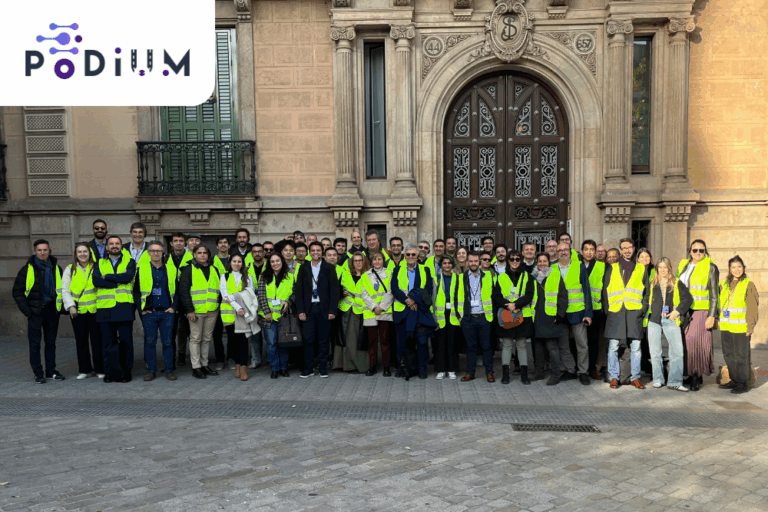
On 19 November, PoDIUM held its Final Event in Barcelona, gathering project partners, industry representatives, and partners from related EU-funded initiatives to present results, explore challenges and lessons learned for real-life CCAM deployment, and demonstrate the project’s Barcelona use case. 70 participants attended the event, making the day a significant milestone for the project and an opportunity to show how PoDIUM’s work advances the implementation of Connected, Cooperative and Automated Mobility (CCAM).
Launched in 2022, PoDIUM focused on advancing the integration of the Physical and Digital Infrastructure (PDI) to enhance communication between vehicles and infrastructure and achieve safer, more efficient mobility. Among other aspects, the project explored connectivity, cooperation, data management, interoperability, and reliability to reach higher levels of automation. The project demonstrated advanced CCAM use cases in real traffic conditions in three Living Labs in Germany, Italy, and Spain.
The final event represented a comprehensive showcase of the project’s achievements, featuring both technical presentations and a live demonstration in the heart of Barcelona. The morning programme opened with welcome remarks from Ángel López (Barcelona City Council), who underlined Barcelona’s vision for urban mobility and how the city is preparing for new mobility technologies. Giorgios Zacharopoulos (ICCS), PoDIUM Coordinator, provided an overview of the project’s journey, reviewing its objectives and key results to enable CCAM deployment.
Presentations from the three Living Labs showcased how the project’s innovations were developed and demonstrated. The German Living Lab achievements was presented by Michael Buchholz (Ulm University) and Tobias Mueller (Bosch). In Ulm, the project demonstrated cooperative corridor management to safely and efficiently handle complex traffic scenarios. The Italian Living Lab showcased trusted cooperative perception for intersection manoeuvre assistance in the city of Turin, presented by Federica Schena (LINKS Foundation) and Alessio Coroneo (SWARCO). Ilaria De Biasi (Autostrada del Brennero) then provided an overview of the use case deployed on the Brenner highway to ensure reliable tracking, real-time guidance and safety warnings to vehicles inside a tunnel. The Living Lab in Spain closed the session with David Porcuna (Abertis Autopistas España) explaining how a responsive PDI system enabled real-time cooperation between vehicles, road users, and operators to improve safety and traffic flows, and Jorge Suárez Luque (ETRA) on PoDIUM’s user-centric approach for priority vehicles and vulnerable road users in dense urban corridors.
The presentations concluded with an insightful panel discussion, “Roads of Tomorrow: from research to CCAM deployment within urban environments”, moderated by Miriam Alvarado (Barcelona City Council). Bringing together city and industry perspectives, the discussions explored the way forward for CCAM deployment, drawing from the PoDIUM experience. Panellists Ana Martínez Roselló (ETRA/AUGMENTED CCAM), Josep Maria Aymami (Aimsun / CONDUCTOR), Samuel Rodríguez Alonso (Eurecat/CARMONY), Cristina Gil Sánchez (Barcelona City Council) and Laura Val Ibort (EIT Urban Mobility) highlighted three core messages: the need for future-ready infrastructure, transparent and secure data sharing, and stronger collaboration and knowledge transfer across public-private stakeholders. The exchange underlined barriers such as infrastructure readiness, harmonised standards, regulatory frameworks and viable business models, and stressed the importance of building public trust through clear communication and evidence from pilots.
In the afternoon, participants moved to the Gran Via for a live demonstration of PoDIUM’s Barcelona use case. Two scenarios were shown under real traffic conditions: an emergency vehicle prioritisation scenario in which the infrastructure gives priority to a firefighting vehicle while a connected vehicle cooperated to perform a safe manoeuvre, and a vulnerable road user (VRU) protection scenario featuring a connected cyclist detected and protected through real-time V2X communication. The demonstrations offered a unique showcase of how PoDIUM’s solutions operate in urban traffic and the safety benefits that integrated infrastructure and vehicle cooperation can deliver.
Want to learn more? Stay tuned for the upcoming video with highlights from the event and demonstration, as well as our final brochure summarising the project’s results. Follow PoDIUM on LinkedIn to stay informed.