
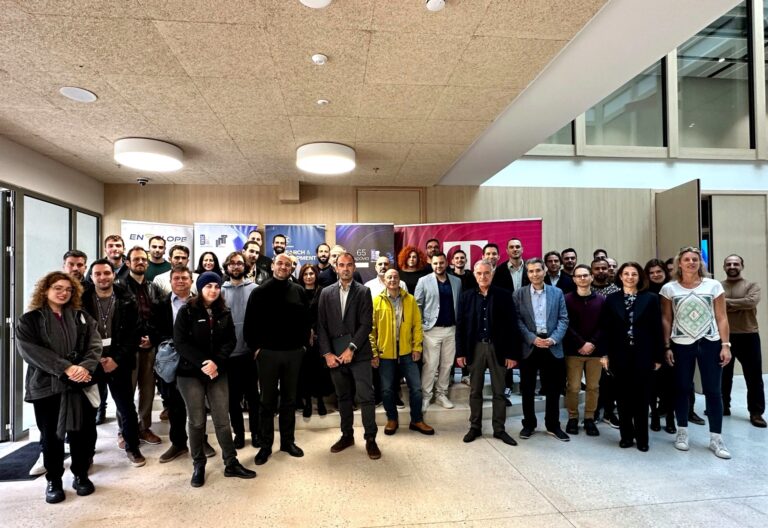
Live demonstrations showcased how advanced network technologies can support connected and automated mobility in real-world experimentation environments.
On 11 November 2026, the Greek Pilot Demo of the ENVELOPE project took place at the premises of the National Centre for Scientific Research “Demokritos” in Athens, Greece.
ENVELOPE – Evaluation and validation of connected mobility in real open systems beyond 5G – brings together research and industry partners to develop, evaluate and validate advanced network technologies for Connected and Automated Mobility (CAM), bringing 5G-Advanced innovation closer to real-world application requirements and experimentation environments.
The ENVELOPE project is coordinated by the Institute of Communication and Computer Systems (ICCS) through the I-SENSE Research Group. Its Greek pilot is implemented within the Athens B5G/6G Experimentation Platform and jointly coordinated by the FRONT research group of the Institute of Informatics & Telecommunications at NCSR Demokritos and the Telekom team (OTE Group). The pilot is carried out in close collaboration with additional project partners: FOGUS Innovations & Services P.C., ISFM–MILLA Group and Leibniz Universität Hannover, each contributing its own expertise to the development and validation of the pilot.
The event opened with presentations introducing the infrastructure and capabilities of the Athens B5G/6G Experimentation Platform, operator perspectives on B5G/6G experimentation and the role of advanced network technologies in enabling connected mobility.
Participants were introduced to key ENVELOPE tools and technological enablers, including advanced connectivity mechanisms such as Access Traffic Steering, Switching and Splitting (ATSSS), Predictive Quality of Service (QoS), and the Experimentation-as-a-Service approach. The presentations also explored network interoperability and mechanisms that support connectivity and service continuity across different network infrastructures.
Four live demonstration scenarios
A key highlight of the event was the live demonstration session, during which participants had the opportunity to explore four scenarios developed within the Greek pilot:
- CAM Application & Edge Selection: demonstrating connected and automated mobility applications and the selection of appropriate Edge computing resources.
- Network Roaming – Service Migration: showcasing network transitions and service migration, aiming to maintain service operation as connectivity moves between networks.
- ATSSS-enabled Service Continuity: demonstrating how ATSSS capabilities can support traffic management and service continuity.
- Greek Site Network Exposure: presenting network exposure capabilities that enable network functionalities and services to be made available to applications and third-party service providers.
The demonstrations highlighted how advanced network capabilities can support demanding mobility applications, enabling greater flexibility, adaptability and service continuity in dynamic environments.
The final part of the event, included several projects (6G-NOW, ZERO-FEST, 5G4LIFE and DRIFT) funded by ENVELOPE through its Open Calls 1 and 2, with the aim of supporting the project’s pilot activities and contributing to the development and uptake of innovative solutions in the field of next-generation networks.
The event concluded with a wrap-up session, providing an opportunity for participants, researchers and industry representatives to exchange insights and discuss the technologies demonstrated during the day.
The Greek Pilot Demonstration marked an important step in validating ENVELOPE technologies within an experimentation environment, highlighting the value of collaboration between research organisations and industry in advancing the future of Connected and Automated Mobility.
ENVELOPE is funded by the European Union under the Smart Networks and Services Joint Undertaking (SNS JU).