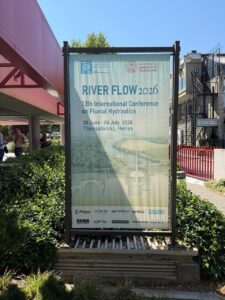
The CARDIMED project was presented at River Flow 2026 – 13th International Conference on Fluvial Hydraulics, held in Thessaloniki, Greece. The conference brought together researchers, engineers and water management experts from across the world to exchange knowledge and discuss the latest developments in river hydraulics, flood risk management and climate resilience.
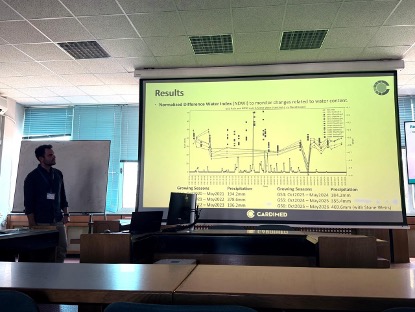
During the conference, Stylianos Kossieris, researcher at the I-SENSE Group of ICCS, presented the team’s latest work on evaluating the effectiveness and scalability of traditional stone weirs as Nature-based Solutions (NbS) through the use of Earth Observation technologies.
As part of the CARDIMED project, the I-SENSE Group contributes to the monitoring of the efficiency of stone weir NBS to quantify the climate adaptation benefits, particularly in relation to stormwater regulation.
 The research presented at River Flow 2026 focuses on the island of Sifnos, where a network of 120 traditional dry-stone weirs has been constructed along two ephemeral streams. These structures slow down surface runoff, reduce flood risk, enhance groundwater recharge, minimise soil erosion and support local biodiversity. At the same time, they revive traditional water management practices that have shaped Mediterranean landscapes for centuries. Building Nature-based Solutions is only part of the challenge. Understanding how they perform under real environmental conditions is equally important.
To achieve this, the I-SENSE Group developed an integrated monitoring framework that combines Earth Observation data, in-situ monitoring systems and participatory observations to assess the environmental performance of the stone weirs.
The study combines satellite imagery from Sentinel-2 and PlanetScope with field measurements and monitoring stations. This approach allows researchers to monitor vegetation health, water availability and hydrological responses after rainfall events. Together, these data provide a comprehensive picture of how the Nature-based Solutions perform over time and under different climatic conditions.
The results presented at the conference highlighted the value of high-resolution Earth Observation data for monitoring small-scale Nature-based Solutions. The analysis showed that PlanetScope imagery can capture short-term changes in water availability after rainfall events with greater detail, supporting the assessment of flood mitigation measures and their potential application in other Mediterranean regions.
The research goes beyond evaluating a single demonstration site. It provides scientific evidence that helps assess the effectiveness of Nature-based Solutions and supports their wider adoption as practical, sustainable and scalable approaches to climate adaptation.
River Flow 2026 offered an excellent opportunity to share CARDIMED’s latest findings with the international scientific community, exchange knowledge with experts in hydraulic engineering and discuss how traditional practices, supported by advanced monitoring technologies, can strengthen climate resilience across Mediterranean regions.